An introduction to human grooming
On this page
Folds in the skin
Your skin is folded all over.
What people call lines and wrinkles are actually folds in the skin.
Your entire body is crisscrossed by folds from head to toes.
Some are obvious, others require closer examination, but most cannot be discerned.
Humans are born with permanent folds in their skin.
| Folds on a baby's wrist |
 |
The folds on this baby's hand won't disappear with time; they'll only get deeper, tighter, and more numerous.
As the baby grows, these folds will restrict joint movement.
Later, some pain will arise when some actions are performed.
Later still, any movement will be limited by the pain generated by the strangling folds.
Additionally, the folds have a detrimental effect on a person's beauty and appearance.
Three ways to groom
There are three main grooming techniques:
• Pressure grooming
• Aquatic facial fold forcing
• Superficial grooming
Each method addresses a specific skin concern, but most of the work is done using pressure grooming techniques.

Pressure grooming
For a complete pressure grooming guide, click here.
Removing your folds with pressure grooming
Pressure strokes are used to unfold the folds in your skin by crushing them.
If you put some pressure on the folds with your nail, you open them up, and break down their foundation.
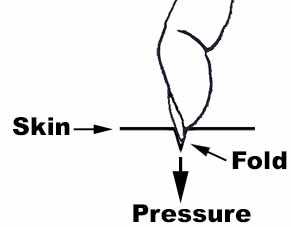
HOW TO PROCEED
• Apply pressure to one spot, with your nail, for one to ten seconds or more,
• Change your position slightly,
• And start over.
You want to open or flatten any hardened surface or detail you encounter.
Exert all the force you can without hurting yourself.
This action may leave nail marks on your skin, but they should fade within a few minutes.
If they don't, reduce the pressure you apply with your finger.
Short and long pressure strokes
Short pressure strokes
Most pressure strokes are short in duration; they last less than five seconds.
Short pressure strokes are the most used grooming gesture.
With them, you can repeatedly flatten and compress any skin imperfection or fold.
You can perform hundreds of short pressure strokes on a very small skin area.
You rely on information coming from your nail, your fingertip, and the skin you are grooming, to guide your efforts.
Long pressure strokes
Long pressure strokes last as long as they are effective.
You only resort to long pressure strokes when you feel that your nail is positioned on a fold crossing, a weak point in the skin structure that you're trying to crush.
• As soon as you realize that you've found such a spot; don't move!
• Freeze your position, while maintaining the pressure.
• Keep on pressing.
• You will feel your nail penetrate your skin, as the cutaneous feature you are grooming yields under the pressure.
• Only end your pressure stroke when no more unfolding occurs.
Why use your nails?
Q: With today's technology, wouldn't there be a simpler and faster method?
A: Your nails are the most adequate and advanced tools for this task.
Their bluntness makes them the ideal instruments to crush and rake your skin.
But, above all, they are super-sensitive; they can feel minute subtilities in your skin condition.
Flat nails appeared about 60 million years ago to allow primates to groom their skin, instead of tearing it with their claws.
You only want to pressure groom your skin where it is folded; not in between.
With your nails, you can discriminate between folded and unfolded skin areas.

Your nail's dull edges allow you to put enormous pressure on your skin in precise locations.
You only want to apply pressure on folds and their crossings.
If you go wrong, you can hold back your nail's action as soon as you feel pain.
Aquatic facial fold forcing
For a complete facial fold forcing grooming guide, click here.
Forcing the folds open
Aquatic fold forcing is one of the most effective human grooming techniques.
But, it's not easy to perform.
That's because both hands are involved:
• One finger follows the path of a fold, and forces it open,
• One finger, from the other hand, holds the skin in place.

Aquatic grooming, whether in the bath, shower, pool, lake, sea, or any other wet place, makes your work much easier.
You don't groom the same way underwater.
Your skin becomes more supple, and it unfolds willingly.
Superficial grooming
For a complete superficial grooming guide, click here.
Incomplete skin renewal
Your epidermis continuously renews itself from the bottom by producing new skin cells.
Older cells are pushed up the epidermis until they reach the top, where they die and flake off.
However, the process has its limits, and dead cells pile up here and there, thickening your skin.
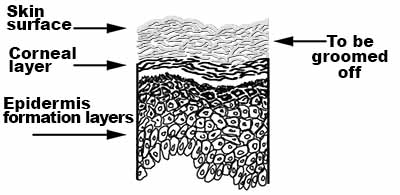
Grooming your skin superficially completes the desquamation process.
Stay away from abrasives such as: rasps, stones, exfoliating brushes or gloves, exfoliating cleansers and soaps, chemical exfoliants, ...
You will get much better results using your nails.
How to groom superficially
Align your fingers, excluding the thumb, so that your nails form a line.
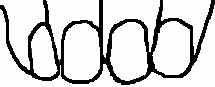
HOW TO PROCEED
Gently rake your skin with your nails, using a back-and-forth motion, while applying a very delicate pressure mostly during the pulling phase.
Your nails should only pass over the same section of skin a few times.
Move your hand and cover your entire body.
In hard-to-reach places; use only one finger.
Grooming basics
Where to groom?
Your entire body should be groomed daily.
However, your skin is supposed to tell you itself where it needs to be groomed.
Itches, irritations, twinges, cramps, aches and pains are all increasingly rude orders to groom specific places.
Ignoring these signals explains your current condition.
You should also groom a region because it shows visible marks, spots, lesions, holes, bumps, or because it has deteriorated aesthetically.
What finger should you use?
You can use any finger you wish.
The index finger on your writing hand is usually the most sensitive.
However, you will often feel the need to use more than one finger to cover large surfaces.
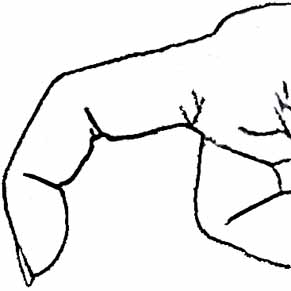 |
| Single-finger grooming |
 |
| Four-finger grooming |
I also recommend using both hands anytime you can.
The second hand can mimic the other, or it can help the grooming hand by stretching and stabilizing the skin.
Finger sensitivity
Each finger feels differently.
Your grooming finger should be your most responsive; your other fingers being less sensitive, in varying amounts.

When you groom, try to vary your habits and alternate the fingers you use.
You generally want to work with your most sensitive digit, but due to its orientation, strength, or fatigue, you might get better results using a different finger.
Finger strength
Some fingers are stronger than others.
Your thumb has the most power, followed by your middle finger.
Each person is different, but here is a simple chart.

Your thumb may not be very agile, nor sensitive, but it's the strength champion.
When you need power to groom hardened areas, use your strongest fingers.
Grooming strokes
One stroke after another
Grooming is accomplished stroke by stroke.
A stroke is the gesture of pressing your finger onto your skin and grooming it for a moment.
You generally start over immediately.
Strokes are repetitious gestures.
They can be divided into three phases;
1• The finger strikes the skin,
2• The nail grooms the skin in some manner,
3• The finger is retracted.
Each grooming stroke can last between half a second and one minute.
These movements have to be done over and over to get any result.
Support and grasp
Any part of your hand not directly involved in the grooming action may act to support it.

Unused fingers can stretch and stabilize the skin or simply anchor your hand to a fixed point on your body.
In some positions, you can rest your whole hand on your skin, relieving you from the weight of your arm.
I also recommend using your other hand to assist the hand that is grooming.
For more on this subject, see the two-handed grooming page.
Moving just the tip of your finger

In many situations, the area to be groomed is tiny, as are fold crossings.
Your nail should peck at the same place repeatedly for a while.
Once your hand is properly positioned, you only need to move your fingertip(s).
Nail and fingertip positions
Using the nail only

The nail then performs most of the sensory reception tasks and all the grooming tasks on its own.
Using both the nail
and the fingertip

Even occasional fingertip contacts with the skin relay mounds of information. Any part of the flesh will do.
Using the fingertip only

You have to use your nails to really groom your skin.
However, using the fingertip only can be helpful to flatten the skin in places where it is ultra-sensitive, such as around the eyes.
Warnings and recommendations
Don't hurt yourself
It's very easy to wound your skin while grooming.
Putting just a little too much pressure may result in a small lesion, abrasion or scratch.
Sometimes, you may even draw blood, and not realize it until later.
Harming your skin won't help it.
Control the force you exert on your skin with great care, mostly when exploring new grooming techniques, or when working on less familiar areas of your body.
Grooming, when performed correctly, should be a rejuvenating experience for your skin, with few negative side effects.
Precautions
Plan your work over a long period.
Each region of your skin will respond differently to your grooming.
If an area reacts poorly to your treatment, suspend all grooming in that area until it heals.
Reversibility
Grooming has the amazing ability to restore your skin's healthy condition.
All the folds on your body can be unfolded.
Even the most severe or long-standing damage seems to be reversible.