Reduced blood circulation and hypertension caused by cutaneous folds
People who suffer from blood circulation problems are often told by doctors that their blood vessels are responsible for their ailments because they've become too thick and stiff.
Grooming proves them wrong, and shows that folds in the skin are the main cause of blood circulation troubles.
On this page
Your blood vessels get folded by your skin
Folds in your skin crush the collapsible blood vessels
Blood vessels are fairly compressible.
Putting even the slightest pressure on your skin, crushes them and reduces their flow.
But, what happens when the skin itself is causing the compression, because it has folded and caught on to what is beneath it?
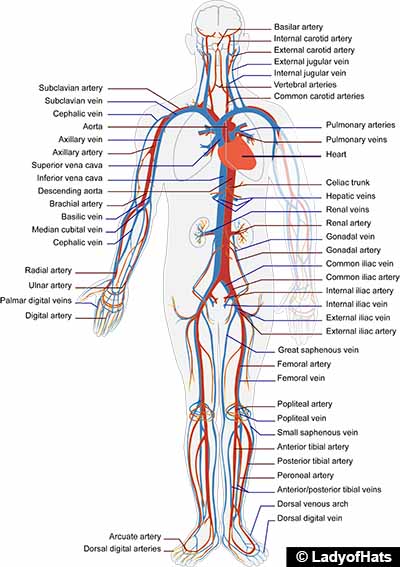
The skin squeezes and flattens the tiny vessels, and reduces the flow in the veins and arteries.
| Human circulatory system - Wikipedia |
|
Folds in the skin cause global and local constriction
The pressure applied by your skin on your cardiovascular system can affect it in two ways:
• Global constriction; causing arteriosclerosis, high blood pressure or hypertension.
• Local constriction; causing atherosclerosis, numbness and tingling sensations.
Global constriction
As you age, your skin loses its elasticity.
It molds and takes the shape of what is beneath it.
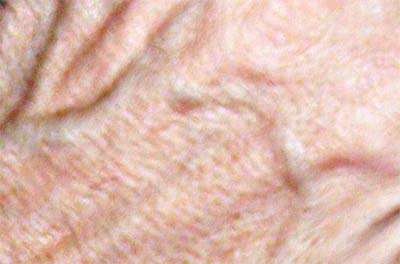
The skin clenches and follows the contour of your blood vessels.
It hugs them so tightly that it puts some pressure on them.
The skin crushes the vessels, and their flow is diminished.
As it hardens with age, and its folds become permanently etched in, the skin oppresses and weighs on the circulatory system more and more.
Local constriction
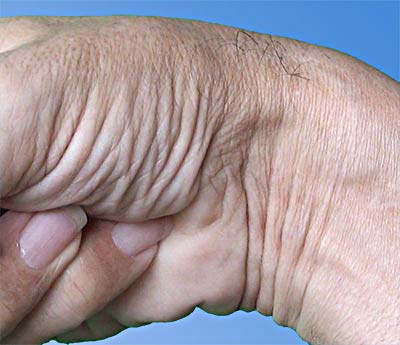
In several places, large folds have developed in the skin of your body, particularly at each articulation.
Not only do these folds deepen throughout your life; they become permanent.
They cut into everything beneath them, including blood vessels.
When you make certain movements or hold certain positions, even while you rest, the folds crush the vessels, reducing their flow or even stopping it completely.
Circulatory problems caused by cutaneous folds
Poor blood circulation
The folds in your skin have a constricting effect on your circulatory system.
All your articulations are surrounded by pleated skin with large folds that dig deep into what is beneath them.
The blood vessels that pass through these joints get bent, twisted, compressed and pinched every time you activate them.
Their blood flow is greatly reduced.
Folds in the skin isolate and leave entire regions behind.
Holding a position for hours or doing the same movement repeatedly only compounds the situation.
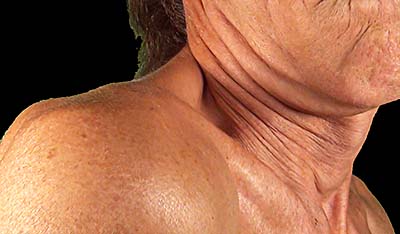
For example, the flow in the carotid arteries, which supplies the brain with oxygenated blood, can be significantly reduced by keeping your head turned for even short periods.
| THE CAROTID ARTERIES |
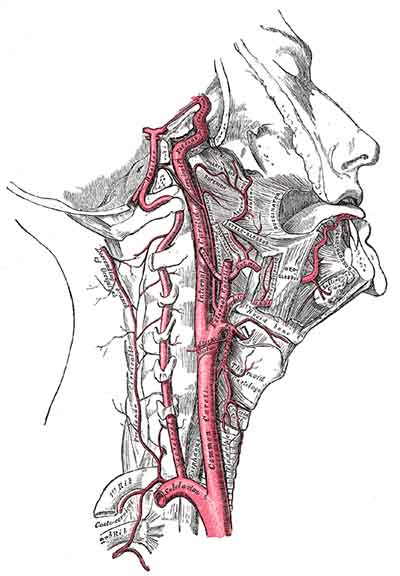 |
| Illustration: Henry Gray |
When the flow to the arms and legs is reduced or stopped, we experience the effects of paresthesia; numbness and the pins-and-needles tingling effect.
However, when the flow to the head is affected, several other phenomena can occur, including dizziness, nausea, short-breath, and headaches.
| Large cutaneous folds in the neck area affect the blood vessels beneath them |
 |
Blocked arteries or Atherosclerosis
The blockages occur where the arteries are bent by skin folds
Wikipedia
Atherosclerosis is a medical condition where the inside of the arteries narrows because of a plaque build-up.
There are no known causes for this disease.
Grooming proves that cutaneous folds may be primarily responsible for the narrowing of arteries.
They crush, compress and narrow the flow of the arteries they cross.
In fact, plaque buildup occurs where blood vessels are bent, and kept folded by the skin.
| Folded arteries and veins Where do you think the plaque build-up occurs? |
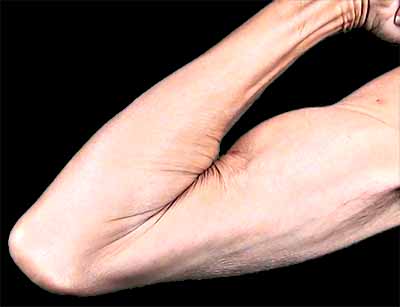 |
Arteries are terribly battered and crumpled as they pass through certain parts of your body, especially at the joints.
Your repetitive movements and sustained postures create deep folds in your skin, and many have become permanent.
The constriction that these folds apply bends and deforms the arteries, hampering and cutting off their flow.
This creates conditions conducive to plaque buildup.
Doctors try to unblock these vessels internally, but the problem could also be cured externally and naturally by grooming the skin of the affected area.
High blood pressure or Hypertension
The pressure that your skin exerts on your blood vessels can lead to hypertension
Capillaries are the tiniest blood vessels in your body.
Their diameter is similar to the width of a strand of spider web silk.
Capillaries not only drench the dermis, they climb up to the epidermis.
The veins that supply them with blood pass just beneath the skin.
All these vessels are easily crushed when you press on your skin, but their flow returns to normal as soon as they are freed.
However, as skin hardens with age and permanent folds have formed, it continuously clamps and clings to your circulatory system; and your blood pressure goes up.
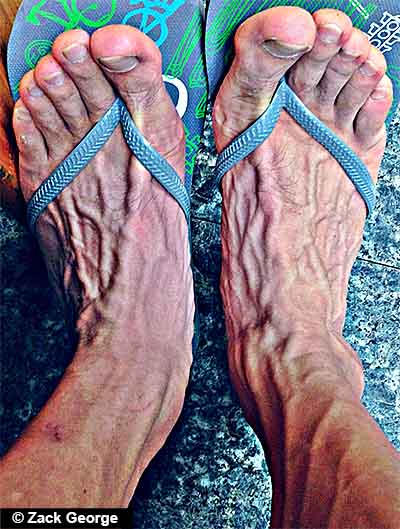
Your skin has lost some of its elasticity because you've never groomed it.
It molds and constricts your circulatory system so tightly that your internal pressure increases.
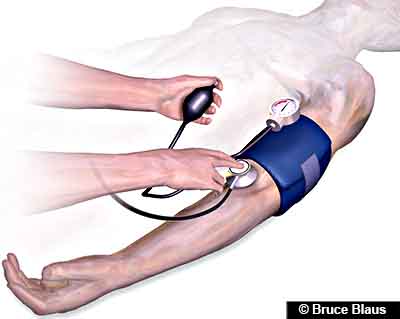
| Pressure taking |
 |
As you grow older, all your folds deepen and many become permanent.
They put more and more pressure on your aging blood vessels.
Every time your heart beats, its efforts to pump out the blood are countered by the pressure your skin applies to your circulatory system.
It's the systolic pressure that's most affected.
Numbness and tingling, or Paresthesia
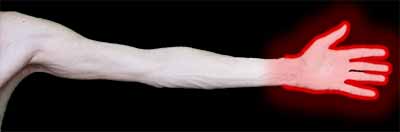
When your arms or legs go numb
We all undergo the discomfort of waking up with a numb limb, because the position we adopted while sleeping cut off blood flow to that part of the body.
This can also occur when you're sitting (possibly with your legs crossed), or even when standing.
When your position returns to normal, you feel some numbness at first, but as blood rushes back to the neglected region, you experience a painful tingling pins-and-needles sensation that slowly fades away.
This phenomenon is called paresthesia, and it occurs when too little blood reaches the nerves.
| Paresthesia |
 |
In fact, cutaneous folds are cutting the flow.
The blood vessels get folded along with the skin.
However, once permanent folds have formed, their presence reduces the flow continuously.
If you experience paresthesia frequently, grooming the large folds in the affected area may reduce or resolve your problem.
Varicose veins or spider veins
Cutaneous folds and their crossings block the flow in the veins
Wikipedia
Once again, scientists have no idea what causes varicose veins.
They say that heredity, pregnancy, obesity, menopause, aging, prolonged standing, leg injuries, and abdominal straining can play a role.
What a joke!
Obviously, these people haven't pressed their nails into the skin of the affected area, because they would have noticed that the skin is folded all over.
Cutaneous folds are to blame, because they directly cut the veins.
However, the worst blockage occurs at fold crossings.
They are like craters for the tiny vessels, that get badly bent and mangled when they reach them.
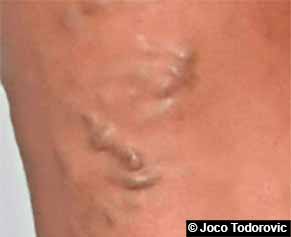
Cutaneous folds cut off blood flow, creating a visible bulge on one side of the blockage.
| VARICOSE VEINS |
 |
The veins are mechanically crushed by the folds in the skin itself.
You won't see most of those folds; they're made of epidermis over epidermis.
However, you can easily feel them with your fingernails.
You must first find the locations where the blockages have occurred.
The exact spots where the occlusion occurs may even be plainly visible.
Those locations are fold crossings, and they can be very small.
At those points, the skin has indented deeply, creating a tiny crater of compacted and hardened cells, in the form of a hole or a bump, through which blood cannot flow.
The only way to get rid of those blockages is to crush these hardened elements away with your nail.
Blood clots or Thrombus
Blood clots occur where the skin is folded
Wikipedia
Platelets are components of blood that react to injury to blood vessels by forming an aggregate, by clumping.
This is a normal response intended to protect tissues; it only becomes problematic when clots obstruct blood flow.
This internal process is very similar to an external one: superficial cicatrisation; the formation of coats of epidermis by your skin to protect itself from repeated folding.
Your blood vessels are repeatedly folded along with your skin when you move or hold a position.
At the point where the folding occurs, the vessels get badly crushed and mangled.
This could lead to injury, so the blood vessels react by thickening their walls.
I'm convinced that blood clots occur mostly in the places where cutaneous folds slice, bend and crumple the blood vessels.
How to restore blood circulation
Free your circulatory system from the pressures of your skin
Grooming your skin can restore normal blood flow to areas where the circulatory problems listed above have reduced or stopped it.
There are two main grooming techniques, you'll have to use them both:
• Superficial grooming; to restore skin elasticity in certain areas of the body.
• Pressure grooming; to free the skin precisely where the blockages occur.
An introduction to human grooming
Human grooming lets you use your nails to unfold your skin, and free your blood vessels.
The following videos will get you started:

|
Human grooming rediscovered - Video |

|
The pain is in the skin - Video |